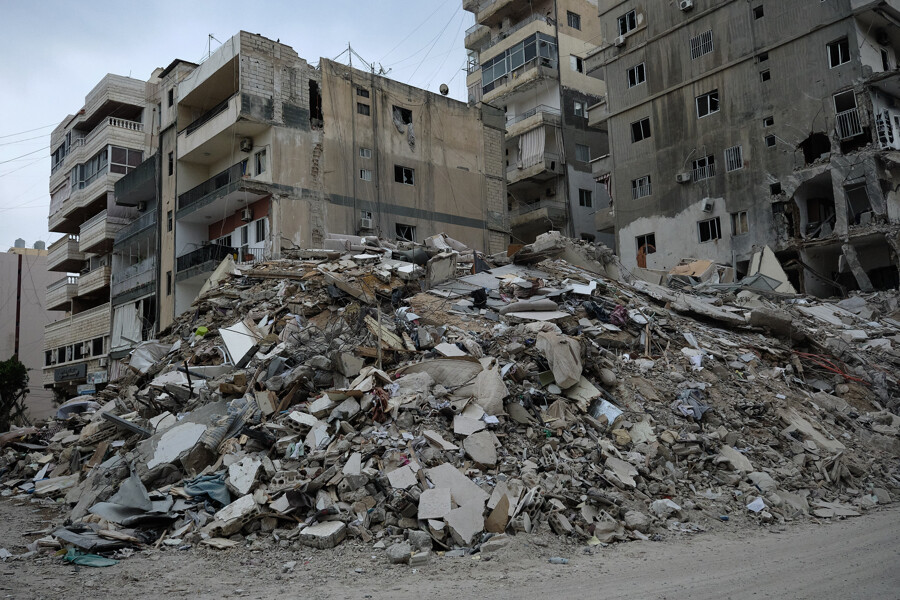
In the city of Tyre in southern Lebanon, the sound of bombs striking nearby villages resonates, while the destruction from the first attacks within the city itself accumulates in the streets, yet many residents still refuse to obey Israeli evacuation orders. 'I have families and children from up there, where they are attacking randomly, while here they are giving orders,' he comments, sitting on the curb of the seaside promenade. Therefore, although most displaced people from the south of the country have preferred to go to Beirut and other more northern areas, some are still taking refuge in Tyre with acquaintances or in one of the active shelters. Over the southernmost part of Lebanon, a massive evacuation order looms, which this week was extended to even more territory, up to the Zahri River. Many of the more than 800,000 people displaced by the conflict, which began nearly two weeks ago, come from this border strip. The road leading to Tyre is almost deserted, but inside the largest city in the region, some shops remain open in the port area, grocery stores with the occasional customer, and a couple of dozen locals stroll along a promenade that was recently full of life. 'The people of Tyre are still here, there are many people here who are not afraid. The one who is not afraid does not leave, and the one who is afraid leaves, and I am not,' one of them tells EFE. This elderly man was one of the few who stayed in the city during the peak of the last war with Israel at the end of 2024, and he acknowledges that the situation then reached much worse levels for those who decided to hold on to their homes until the end. 'Last year was more difficult for Tyre, last year they bombed a lot around us,' he recounts. In comparison, this time the town has only been the target of a few attacks over the last two weeks, the resident highlights. In the city center, a huge mountain of rubble from a twelve-story building that completely collapsed after being hit days ago has turned a two-way road into a narrow corridor through which vehicles take turns passing. Not far from there, the remains of burned-out machines in a wasteland mark the point where another missile struck, which targeted several generators that supplied electricity to the population to supplement the scarcity provided by the state system. The elderly man says that the Israeli army has been issuing evacuation orders before launching these attacks in Tyre, unlike other towns further south. 'People come and share with everyone, whoever wants to eat, they are fed,' he concluded. Or unlike 'up there,' as he says. 'I have twenty displaced people in my house who come from up there. There are even, he says, volunteers distributing food to break the fast during the sacred Muslim month of Ramadan. 'People come and distribute food here at the time of 'iftar'. One of the oldest cities in the world, founded by the Phoenicians around 2,750 BC, Tyre is known for hosting two archaeological sites declared World Heritage by UNESCO. But on March 6, a bombing struck near one of them, the Roman necropolis of Al-Bass, which suffered damage within its perimeter, as reported by Lebanese Minister of Culture, Ghassan Salameh. A UNESCO spokesperson also confirmed to EFE damage in Tyre, although they have not yet been able to dispatch a team to the ground due to the security situation. In the midst of the air offensive and evacuation orders, a resident estimates that about 70% of the city's population has already left the area. 'It is difficult and not many stores are open, the economic situation is bad,' laments the 20-year-old to EFE, adding that half of the products are not available in supermarkets. Additionally, the attack on the generators has left some people without electricity, although the neighbor explains that others have contracted services with machines elsewhere or have solar panels. In contrast, for the elderly man on the seaside promenade, seasoned in a war of a brutality not yet reached by the current one, there are no complaints about the lack of supplies.